Long-term inflation expectations climbed sharply in May as the Middle East conflict drove Brent crude above $100 per barrel through disruptions in the Strait of Hormuz.
Hawkish Waller Speech Jolts Rate Cut Outlook
25 May 2026 - 10:00 CEST

The University of Michigan Surveys of Consumers – a widely followed gauge of household sentiment on economic conditions, personal finances and inflation – showed long-run inflation expectations rising from 3.5% in April to 3.9% in May. This marked a notable increase from the 2.8% to 3.2% range that prevailed throughout 2024. The survey found the jump reflected sizeable increases among independents and Republicans. It also noted that 57% of consumers spontaneously mentioned high prices eroding their personal finances, up from 50% the previous month.
Waller strikes hawkish tone
Federal Reserve Governor Christopher Waller struck a hawkish tone in his speech titled "Policy Risks Have Changed," delivered on 22 May at the Centre for Central Banking Guest Lecture in Frankfurt, Germany. Waller, a Trump-nominated member of the Fed board known for his data-driven approach to monetary policy, acknowledged that earlier rate reductions were appropriate given expectations that tariff effects would prove temporary.
However, he said higher energy and commodity prices linked to the Iran conflict are pushing up headline inflation and broader goods prices. "Inflation is not headed in the right direction," Waller said, according to his prepared remarks. Based on recent data, he would support removing the "easing bias" language from the policy statement. This would signal that a rate cut is no more likely than a rate increase going forward.
"That doesn't mean, however, that I think we should be considering rate increases in the near future," he added.
Warsh task gets tougher
The shifting backdrop poses fresh challenges for the Federal Reserve under new leadership. Kevin Warsh, a former Fed governor with experience navigating the 2008 financial crisis, was sworn in as chair on 22 May following his nomination by President Donald Trump, who seeks lower interest rates. Warsh now confronts a resilient labour market paired with rising inflation pressures and elevated long-term expectations.
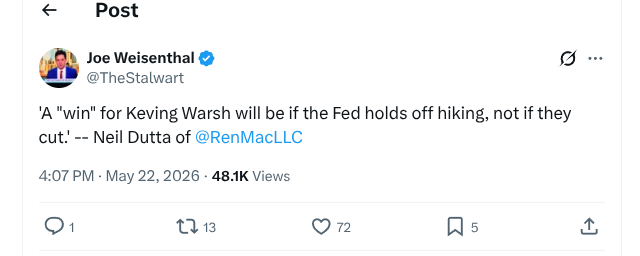
Markets reacted to the combination of firmer inflation expectations and Waller's remarks with higher Treasury yields and a stronger US dollar. Neil Dutta, head of economic research at Renaissance Macro Research – a firm providing macroeconomic analysis to institutional investors – said: "A 'win' for Kevin Warsh will be if the Fed holds off hiking, not if they cut."
June FOMC in focus
With the next Federal Open Market Committee meeting scheduled for June, investors will watch closely for any shift in the policy statement and new projections. The data-dependent stance faces added complexity from persistent energy price shocks and solid domestic demand, potentially delaying anticipated easing.
The combination of firmer long-term inflation expectations and Waller's comments could dampen hopes for imminent rate cuts. For both institutional and retail investors, the evolving Fed stance adds uncertainty to an already complex macroeconomic picture shaped by geopolitics, energy prices and domestic politics.