Litecoin, a proof-of-work cryptocurrency launched in 2011 as a faster, lighter alternative to Bitcoin, has rewritten part of its recent transaction history to fix a security flaw in one of its privacy tools. The network replaced 13 blocks – roughly 32 minutes of activity – after attackers used the bug to disrupt operations.
Litecoin Reorgs 13 Blocks After Privacy Feature Exploit
27 April 2026 - 11:50 CEST

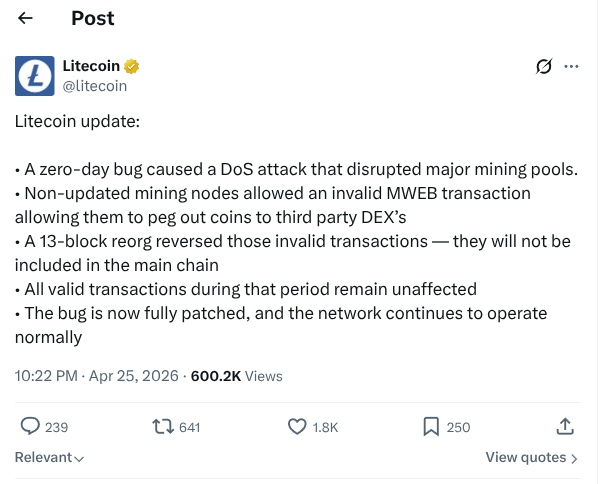
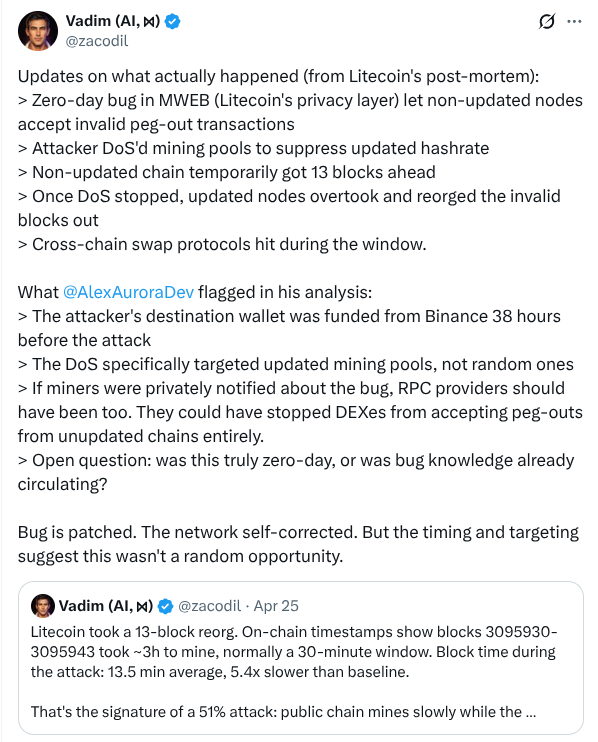
On 25 Apr, Litecoin announced via X that attackers had exploited what it described as a previously unknown vulnerability. This allowed invalid transactions to enter the system through mining pools that had not yet installed the latest software update. The team quickly applied a fix and reorganized the chain to remove the bad transactions while keeping legitimate ones safe. The entire network returned to normal operations within hours.
LTC (LTC), Litecoin’s native token, closed out the day down around 1% at $56.08, having dipped as low as $55.93.
What is MWEB?
MWEB, or Mimblewimble Extension Blocks, is an optional privacy upgrade added to Litecoin in 2022. It works like a side section of the blockchain where users can send LTC with hidden amounts and addresses, similar to making a private cash transfer instead of a public bank wire. Most activity stays on the main transparent chain, but users can move coins into MWEB for more confidentiality. The exploited flaw involved how these private blocks were checked for validity.
Impact on everyday users
According to the Litecoin Foundation, no funds were lost by regular holders and standard onchain transfers remained unaffected. The reorganization mainly reversed invalid attempts to move coins out of the privacy feature to external exchanges. One cross-chain bridge reported a potential $600,000 exposure that was later addressed, and most users experienced only a short delay in confirmations during the incident.
Reorgs in proof-of-work blockchains
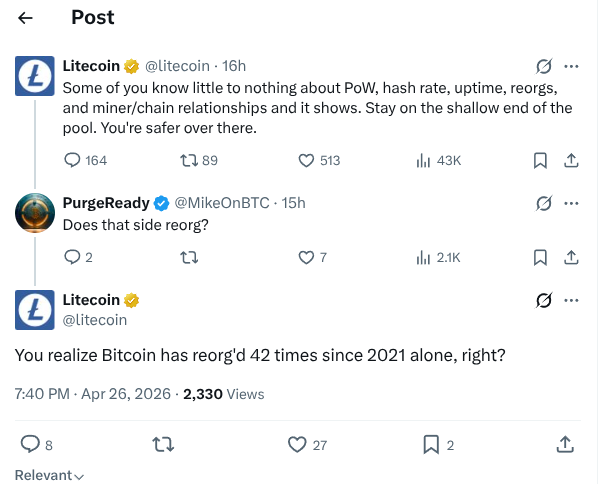
Litecoin runs on proof-of-work, the same system Bitcoin (BTC) uses. In this setup, specialized computers called miners compete to solve complex maths puzzles and add new blocks of transactions every few minutes. A reorganization, or reorg, happens when the network agrees to discard some recent blocks and replace them with better ones. It is a built-in safety mechanism but can feel unsettling because it temporarily changes recent history. The Litecoin Foundation pointed out on X that Bitcoin has undergone dozens of similar reorgs in its early years.
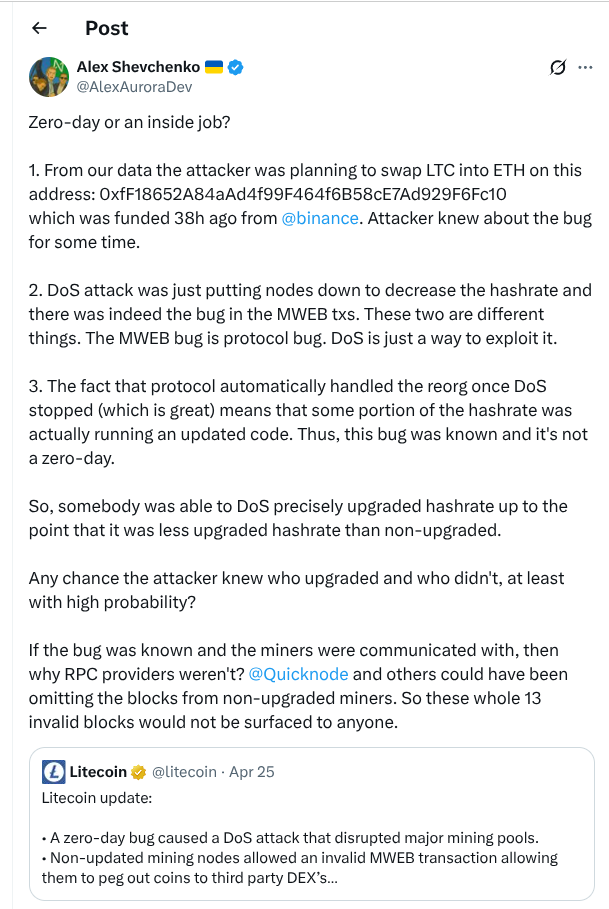
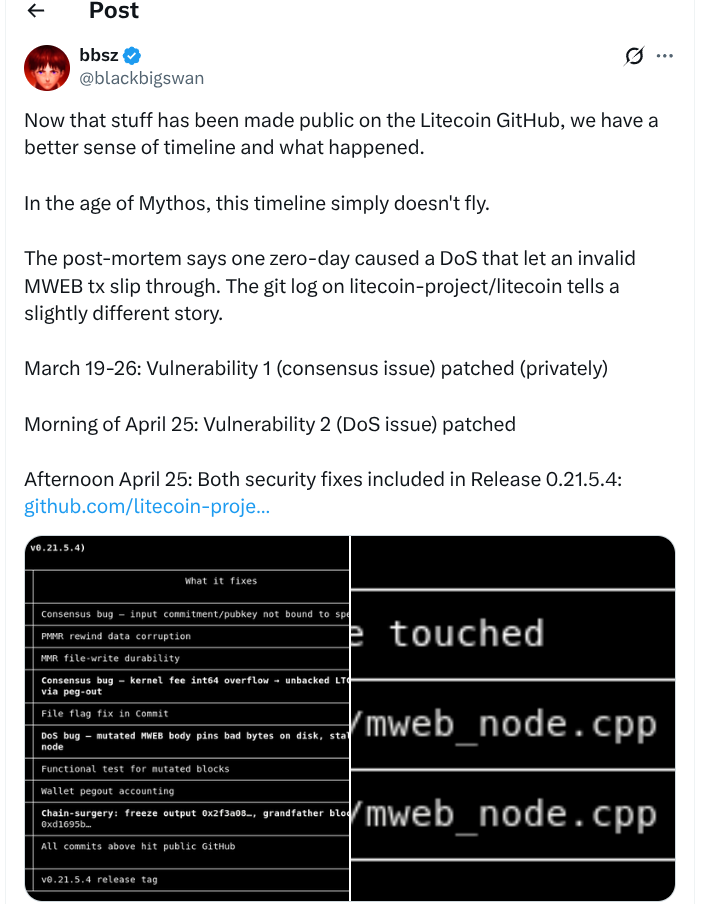
Some community members and analysts questioned whether the bug was truly unknown. Records on the official Litecoin GitHub repository (litecoin-project/litecoin) show developers privately patched the core consensus vulnerability between 19 and 26 Mar – roughly four to five weeks before the attack. A related denial-of-service fix came on 25 Apr. Not all miners had updated their software, leaving a gap that attackers exploited. Aurora Labs CEO Alex Shevchenko, one member of the community, said on X that the attacker had also loaded a wallet with funds from Binance about 38 hours before the incident, hinting at possible insider involvement.
Context among recent crypto incidents
This event is one of the more significant reorgs on a major proof-of-work network in recent years. Smaller chains like Ethereum Classic have seen deeper reorganizations in the past, often linked to double-spend attacks. It comes amid a busy month for crypto security issues. In April 2026, North Korean-linked groups reportedly stole nearly $600mn from DeFi platforms including Solana-based Drift and Aave-related Kelp DAO through social engineering tactics.
The episode exposes persistent coordination weaknesses in proof-of-work networks outside Bitcoin’s orbit. Despite a swift technical recovery, the gap between private patching in March and widespread deployment left enough unpatched hashrate for the exploit to succeed. Security researcher bbsz (also known as @blackbigswan), who works with the SEAL911 emergency response group for crypto exploits, and onchain analyst Vadim Zacodil (@zacodil), a blockchain developer and former NEAR core contributor, noted on X that this raises fresh doubts about upgrade discipline on mid-tier chains and serves as a reminder that settlement finality on smaller PoW networks carries inherent risks compared with larger, more decentralized ones.
The Litecoin Foundation described the reorg as a necessary defence of network integrity and pledged improved communication around future updates.