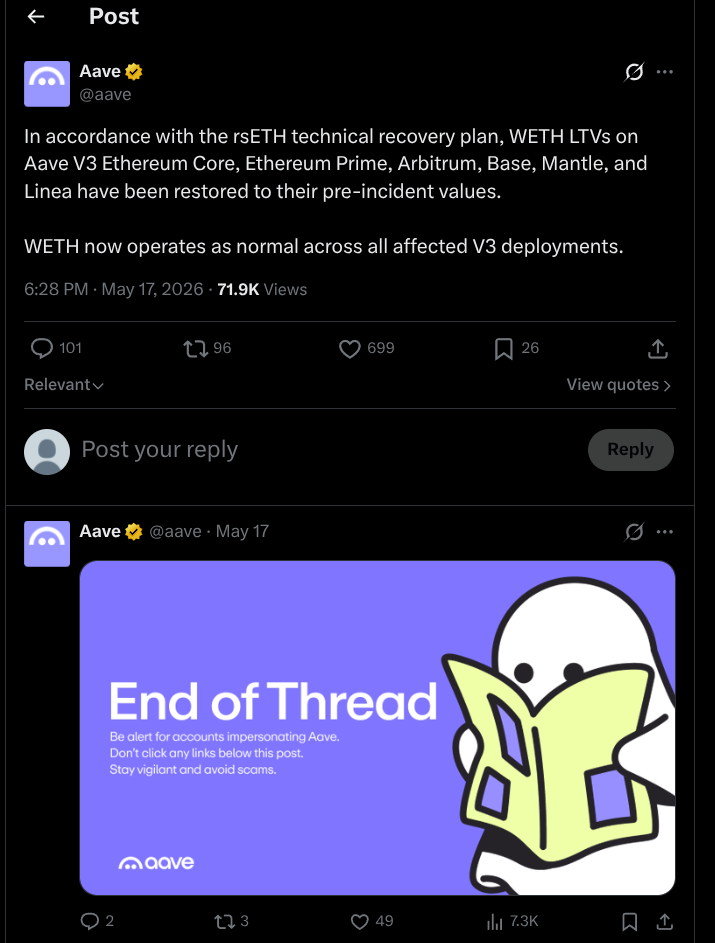
Aave has restored wrapped Ether (WETH) loan-to-value ratios to pre-incident levels across major V3 deployments, reopening borrowing capacity and signalling strong recovery from the April Kelp DAO exploit that triggered a $6bn drop in total value locked.
Aave Restores WETH Collateral Limits as rsETH Recovery Effort Gains Ground
18 May 2026 - 21:54 CEST
By Sandmark staff

The noncustodial lending protocol – which lets users supply crypto assets as collateral and borrow others without a central intermediary – reversed emergency restrictions after weeks of tightened parameters. The move reflects progress on the rsETH recovery plan and restored market confidence.
Emergency controls reversed
In an update on X, Aave founder Stani Kulechov stated: "The next step in the rsETH technical recovery plan has been completed with the restoration of WETH LTVs to their pre-incident levels across all affected networks. Users can now once again borrow against WETH on Aave, including through collateral and debt swaps."
Aave returned WETH loan-to-value ratios – the percentage of an asset’s value that can be borrowed against – to pre-exploit settings: 81% on Ethereum Core, 84% on Ethereum Prime, 80% on Arbitrum, 80% on Base, 81% on Mantle and 80% on Linea. During the crisis, the protocol had lowered these to zero.
The 18 Apr incident saw attackers exploit compromised LayerZero verifier infrastructure linked to Kelp DAO. They minted roughly 116,500 unbacked rsETH – about 18% of the token’s circulating supply. rsETH is a liquid staking token issued by Kelp DAO that represents staked Ether and earns additional yield. The attackers deposited the tokens as collateral on Aave to borrow approximately 82,650 WETH ($190mn) and smaller amounts of wstETH.
Liquidity shock contained
The exploit triggered a rapid liquidity crunch. Aave’s total value locked fell from roughly $26bn to near $20bn within days as users withdrew funds amid contagion fears. WETH utilization rates hit 100% in several pools, restricting withdrawals.
As of 18 May, Aave’s total value locked stands at approximately $14.5bn according to DefiLlama data, with active loans around $11bn. The protocol has regained meaningful ground while maintaining leadership in DeFi lending depth.
Aave froze rsETH markets on affected V3 and V4 deployments, reduced WETH collateral parameters and adjusted interest-rate models to protect solvency. Its internal safeguards prevented wider bad debt crystallization.
Recovery effort advances
Aave coordinated with Kelp DAO – the issuer of rsETH – LayerZero – a cross-chain messaging protocol – and partners under the DeFi United framework. The group raised over $300mn in commitments to rebuild rsETH backing at a ratio of 1.07 ETH per rsETH and support impacted users. Earlier in May, Aave executed governance-approved liquidations of hacker-linked positions via oracle adjustments, avoiding broader disruption.
This restoration of standard WETH parameters immediately boosts borrowing capacity for both retail and institutional users. It enables renewed leverage strategies, debt swaps and liquidity provision previously unavailable during the emergency phase.
Forward-looking implications
The normalization could drive renewed demand for rsETH and similar liquid staking tokens. It also provides practical lessons for other protocols on bridge risk assessment and collateral calibration in interconnected DeFi environments.
Aave continues to lead DeFi lending by total value locked and liquidity depth despite the temporary drawdown, demonstrating resilience in a maturing ecosystem. Governance processes for full restitution remain active, but the eased restrictions signal materially lower systemic risk from the exploit.
LlamaRisk, a key Aave risk service provider involved in the incident response, noted the coordinated industry effort helped contain fallout effectively.